
BY PAUL ABBOTT & SEYMOUR WRIGHT
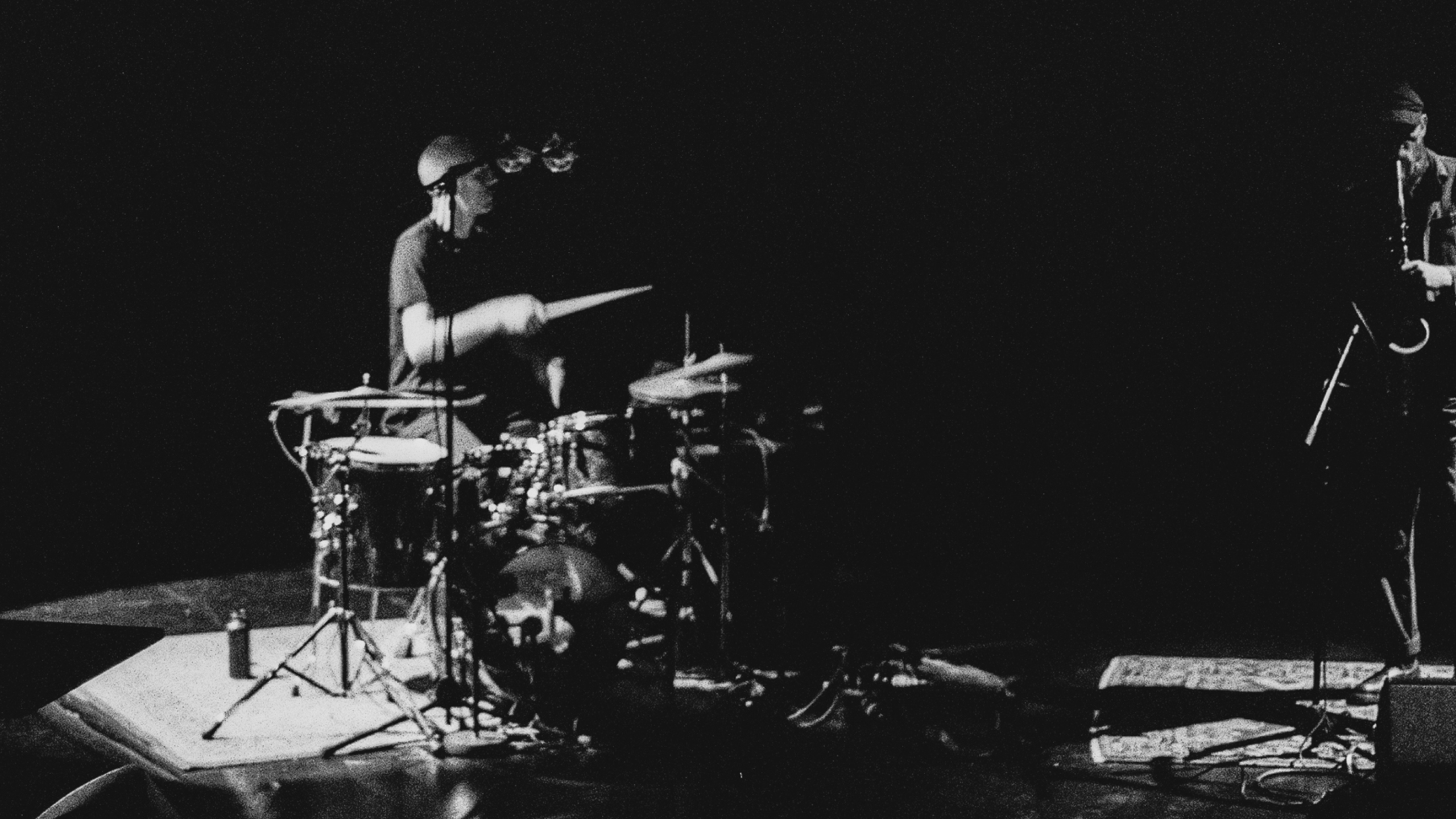
XT is our duo. Paul Abbott on real and imaginary drums and Seymour Wright on actual and potential saxophone. The structures we work with and make as XT en-sound an ongoing attempt to listen and learn about the rich and transformative affordances of the situations we occupy.
The words that follow here re-work, index, and add to things from the records we’ve made (so far) in order to articulate and exemplify some of this listening and learning. Learning, for example:
about, sound[ing] out and communicat[ing] with material like Clarice Lispector’s jellyfish (again), the ear-ring on the cover of Ornette Coleman’s Love Call; Dionne Warwick singing “You Can Have Him” on Italian TV; Paulinho Da Viola’s melancholic Atlantis heart; footwork; Ann Quin (and the sea); tech prosthetics; perhaps by then Anna Halprin; the inspiration of our friends; bits of our homes and other work; the OTO Project Space […] where we worked; and what we imagin[e] all of this to (possibly) be.
We re-purposed this paragraph in the liner-notes to our 2020 LP Deorlaf X. That studio record was about Cafe OTO in London, and the many-years’-worth of the concerts we have done there. “About”, to re-work some of the liner-notes, us thinking about:
how to make a document about this work? [To do so] we chose to return to, re-animate, re-work, and re-fill the material of these many recordings. We chose to take these respective concerts’ compositions – each a structure for improvisation and learning – and to restructure them. To make them the material for a document of an on-going dozen years of work. An ‘overview of – and an immersion in – layers of the live, fossil unconscious’ [in Wilson Harris’ words].
We did this over three days in a studio in January 2020, working with Shaun Crook. We took the Légerian progression of one composition – “Love Calls” – and emptied it out. We shifted its fulcrum, the waves of its heart. We filled it with areas of other compositions: the four versions of “A’a lava” were folded and pressed into one (and poured into our instruments); a section of “Submersa” – ‘nas ruinas da cidade submersa’–sunk under further waves of OTO; and so doing we (re-)possessed the sounds of a Love Call with the happy dance of a spaced grid. It begins and returns with glimpses of reflection on Charlie Parker and Ornette. [And so] XT structures sound an ongoing attempt to listen and learn about the rich and transformative affordances of the situations we occupy. [To quote Anthony Braxton’s liner notes to Town Hall, 1971] “The real became us too, everything we felt when living.”
This extends to the remarkable Leon Kossoff painting Dalston Junction No.3, June 1973 on the cover.
Another example is Palina’Tufa from 2018. A studio 2-LP that was, as we explain in the notes:
a set of responses to a certain combination, a nexus on which we found ourselves balanced. An instance of poise that occurred in May 2017 when we spent two weeks in Hong Kong at the invitation of Empty Gallery. This record is the sonic result of that fortnight of activity. We stayed in Tian Wan (Aberdeen) and commuted daily to David Sum’s recording studio in north west Kowloon to work with him and Tomas Chan.
The document that we were able to create was a response to the experience of that block of Hong Kong’s stacks: feelings, people, technologies encountered. It is comprised in a sense of the fabric of some of the materials that we took with us stirred into the sensations. These were objects – conceptual objects, tissues, and structures that we had been exploring in the run-up to our trip. Several of these became particularly important filters and tools – technologies, even – for us to use in our explorations and existing in Hong Kong.
How does this exploring of ‘conceptual objects, tissues, and structures’ move and work? Perhaps through ‘angles of incidence’:
between city and nature, through jungle to beach, and mortal/vital power of music, was a particular fulcrum that we sought to navigate, delineate and balance. We were led there by, for example, a section from Los Pasos Perdidos/The Lost Steps, by Alejo Carpentier. And in working with this stuff, we were drawn towards synthesis: perhaps a little like Jayne Cortez ‘articulates’ in this excerpt from her 1984 poem, When I Look at Wifredo Lam’s Paintings:
(They) burn up the brushes
with raffia swishing and shooting from
buttocks of vibrating nostrils
with knee-caps swelling on stilts of
bowlegged nails
with grinning horses galloping from
navels of frying fat
with purple stems of cane protruding from
green lips of machetes
with zigzagging flamingoes fluctuating on
the roof tops of Matanzas
They billow and overlap in broaches of
charcoal spittle
They cross and dissolve into
a fleet of orange blotted organs
They have their bull horns
their yellow snake arrows
their triangular forest skulls
their blood vessels sprouting from daggers
their upside down faces in pelvises rotating
and perforating in spider specked sex of the gouache
This transition from the idea-fabric of one stuff to ideas-fabric in another stuff was the poise that we were perhaps attempting to find. A note we produced during one of our daily discussions of this fleshes things out a bit:
Following the Real and Imaginary through “Angles of Incidence”—Stacks: following cylinders, tubes, pipes, columns, the Shawm, electrical and animal life; Orbits: following Chinese folk music, weather systems, “spill”, ascending paths, concentration, horizontal valley, vegetation, geology, altitude. & After Banyan, Sanban, Luishui, Touban, Kaopai (Folk Music Of China, Living Instrumental Traditions, Steven Jones): blowing and beating, percussion mnemonics, beats and eyes, water pulse, whipped and urging beats.
This gives, we hope, more of a sense of what we were doing. And this example – Composition 117 (from Book E of his Composition Notes) – of Braxton-ian nexul poise, nexul process may help explain things further, alongside the Cortez and Carpentier referenced above:
Braxton’s structure, though not a composition that we were performing in any sense, was important in offering support, a kind of counsel to the structures we were building, as was this related comment:
Chinese music seems to have been centred on a pentatonic scale, each of whose notes – Kung, Shang, Chiao, Chi and Yu; was integrated into a network of symbolic correspondences which encompassed politics, the seasons, the elements, colors, directions, planets, and domestic animals.
The title of this record – Palina’Tufa – and its cover artwork, further exemplify how we found ourselves ‘integrated into a network of symbolic correspondences’, poised between distinctions.
On the final day of our recording, we found the body of a beautiful lepidopteron in a corridor. Papillo palinurus, a light creature with no apparent relationship, or indigeneity, to Hong Kong. This ‘sat’ oddly on top of a theme that had slowly emerged during the course of our two weeks’ work: the geology of Hong Kong’s islands. This remarkably cosmopolitan metropolis is built on an anciently volcanic substance – tuff. This example of co-incidence, oddly, articulated and connoted an example of the poise that we had been fathoming.
At around the time of our Palina’tufa activity, our friend the artist Will Holder was working with Kosen Otsubo. By chance, through Will, we encountered Otsubo’s work, specifically his 1978 book Plant & Man [or sometimes Botanical Man]. To us Otsubo’s ikebana felt expressive of some of the complexity and play produced through trying to balance the tissues of nature(s) and technology(s) – perhaps a bit like the experience of moving through – exploring, living – a city.
Our working together works in folds and steps, swinging like that, in the above ways of working with, and sharing, (real and imaginary) space, time, stuff, sound, ideas.
And then, when we collaborate as XT with other people in trio (regular on-going work with Pat Thomas, or Anne Gillis, or Kavain Wayne Space [RP Boo]), it’s also a bit like this. We work in contrast with, while informed by, our duo-dialogical accumulations. But it’s a differently human and living version of the processes that these notes on Deorlaf X or Palina above articulate.
With/in/through these trios we learn about what we share, and how we diverge, what we are interested in (and not), and what idioms we might be (inclined to, or emerging from), mainly through the great sharing of living, lived, and live sounds. Being together in sound. The live occasions which permit us some time together afford us brief adjunct opportunities to poetically explore/embody the [extra]music[al], by extension, through eating, walking, travelling and being together.
In advance of performances – which more often than not become ‘records’ – we often spend some time preparing material. Conceptual stuff. Haptic stuff. Emotional stuff. Talking about structures that might organize musical material in time. The ideas which inform the structures are often ‘grown’ in some (often imaginary) relationship to the place we will perform. Sometimes that is a new place: a place we have not played at, visited, and have no prior experience of; other-times it is somewhere familiar to us, where we have a history, an accumulation of experiences, like Cafe OTO, in London.
We have a flexible, changing approach to preparing for and performing live. An ongoing experiment into ‘attitudes of preparation’ informed by what we might have done before, by what we might want to learn, new; by models we find in other musicians’ and artists’ practices, ideas, and in everyday life (among other things). An articulation of how this might work unfolds column-ally across the four panels of Will Holder’s design for our 2023 2-LP with Pat Thomas, “Akisakila” / Attitudes of Preparation (Mountains, Oceans, Trees). These attitudes of preparation are part of a process of continuing to imagine and re-imagine our music: our past, present, and future music rolled into one, through the routines of musical doing. This is also, somehow, depicted in the panels of YESYESPEAKERSYES painted by Benedict Drew with whom we played in a trio before XT. And also before (and adjacent to) XT, we both work(ed) in the trio group lll人 with Daichi Yoshikawa. Of that group, we said that “the tools are familiar, [but] the listening is not.”
The organising principles that emerge from thinking about a next performance, listening to old material, reading new things, and being mixed in the present (and presence) of everyday life are loose, wobbly, porous, provisional, sticky, and limber. As we have mentioned elsewhere, we work with what feels like a bunch of ‘ingredients’: some guiding ideas each with a particular flavour (e.g. fill, empty, orbit, donut/torus) often working (for us separately) with and produced in relation to the relationship we have to our instrumentation (saxophone, drums) (and together) (saxophone-drums). We support each other in an ongoing individual-shared exploration of the history and potential of our instrumentation.
In XT music, and its relationship trios, we continue this idea-relationship: we make music with tools, ideas, and historical material available to anyone, finding ways that make sounds and feelings which make sense, make meaning, to us.
The three parts of the Strata, Act (Joy Contemporary)* suite, released on January 31, 2026, on We Jazz Records, by XT and Pat Thomas continue, develop and expand this work.
Published in We Jazz Magazine, issue 18, spring 2026.